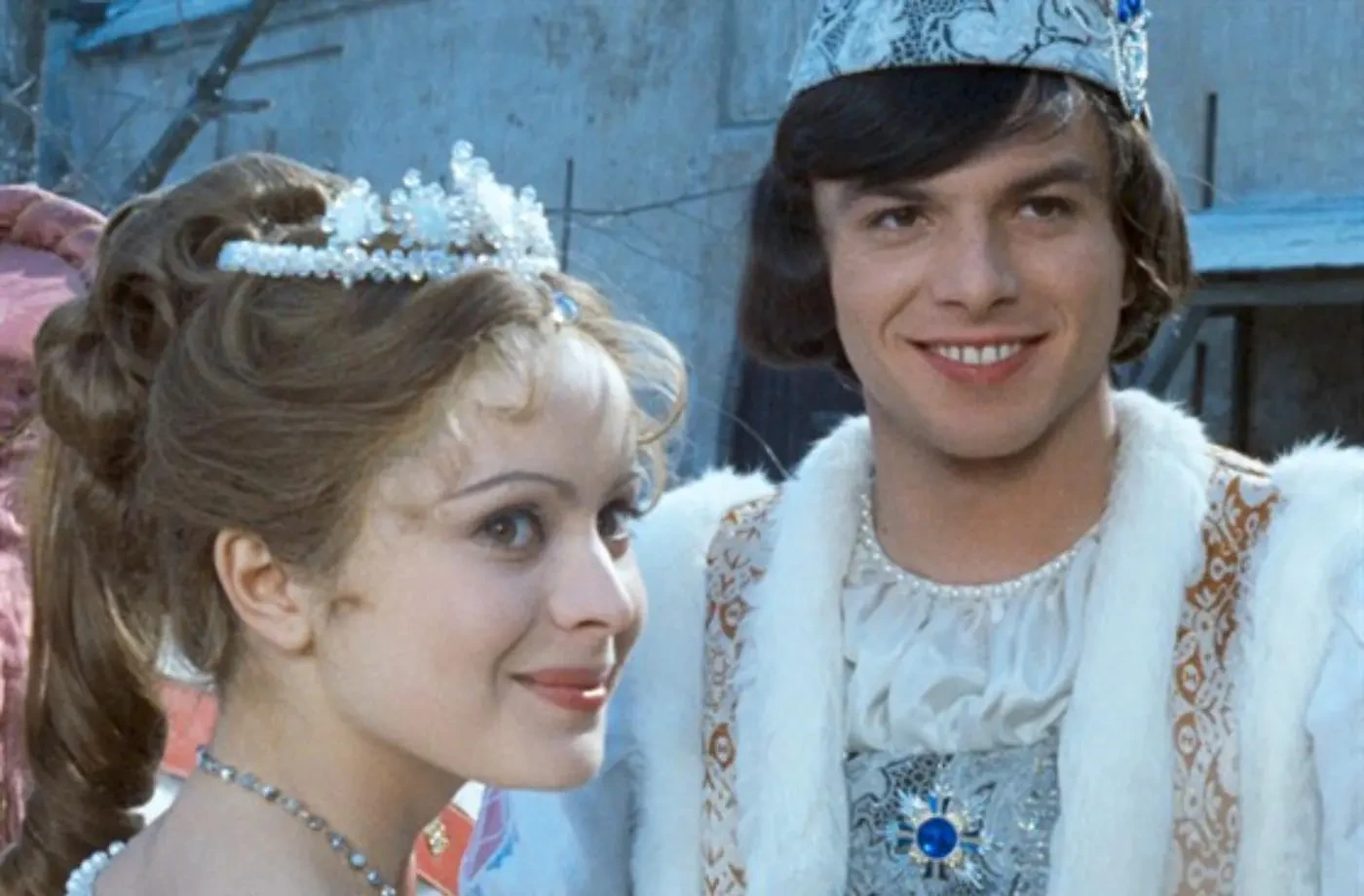
A few shots of a snow-covered landscape, the irresistible melody of Karel Svoboda, and the bright smile of Libuše Šafránková – for millions across Central Europe and far beyond, this isn’t just a film. It is the undisputed symbol of Christmas. The Czechoslovak-East German co-production fairy tale, Three Wishes for Cinderella (Tři oříšky pro Popelku), released in 1973, is a timeless cinematic gem.
More than 50 years after its premiere, the story of the brave Cinderella, who finds three magical hazelnuts and a crossbow instead of expensive gowns, continues to break viewership records. Why did this particular adaptation of the classic tale become such a global pop culture phenomenon? Dive with us behind the scenes to uncover the surprising facts, incredible coincidences, and find out why this unique Cinderella captured the hearts of the world.
The Faces Behind the Legend: Libuše Šafránková and Pavel Trávníček
The Cinderella That Almost Wasn’t a Cinderella
The casting process for the leading roles was full of unexpected twists. Director Václav Vorlíček initially favored actress Jana Preissová for the role of Cinderella. Fate, however, intervened. Preissová had to decline the part as she would have been heavily pregnant during the filming schedule.
Vorlíček then recalled the young, nineteen-year-old Libuše Šafránková, whom he had seen in the film Babička. Her crucial advantage? She was an excellent bareback rider—a key skill for this more active and independent version of Cinderella.

The Prince Who Needed Dubbing
A similar “coincidence” led to the casting of the Prince. While other actors were considered, the role went to Pavel Trávníček, supposedly because he resembled French cinema star Alain Delon.
Trávníček’s strong Moravian dialect posed a problem for the Czechoslovak version, and he was subsequently dubbed by actor Petr Svojtka.
Watch Three Wishes for Cinderella on Apple TV.
The Stepmother Who Spoke German
An interesting linguistic situation arose with the villainous roles. The Stepmother was played by German actress Carola Braunbock, a former German émigrée. During filming, she spoke exclusively in German. It was only later revealed that she actually knew Czech, but apparently chose to use German for personal reasons.

Behind the Scenes: From Smelly Snow to Freezing Cameras
Filming the idyllic, snow-covered fairy tale in the winter of 1972/1973 was anything but idyllic. It was one of the most challenging film projects of the era.
It was meant to be summer: The original script by František Pavlíček (who was politically persecuted and thus uncredited) was initially conceived as a summer fairy tale. However, because the film studios were only free in winter, the script had to be rushed into a winter setting.
The Smell of Fish Bones: To create a huge amount of artificial snow, the Czechoslovak side used Styrofoam. However, the German production opted for a more “natural”—and incredibly pungent—solution: ground-up fish bones mixed with a chemical additive! When the sun hit this mixture, the smell was reportedly overwhelming.
Two “Jurášeks”: Due to customs regulations at the time, which made transporting animals across borders difficult, two different horses played Cinderella’s mount, Jurášek, in the Czech and German segments.
Helena Růžičková’s Improv: The famous scene where the plump Droběna (Helena Růžičková, called “Kleinröschen” in the German version) corners the Prince during the dance was entirely improvised. It was a spontaneous idea by the actress herself that perfectly fit the film’s comedic tone.
The filming locations are now popular tourist destinations: the farmhouse scenes were shot at Švihov Water Castle near Klatovy, while the Prince’s castle is Moritzburg Castle near Dresden, Germany.
Karel Svoboda’s Music: The Sound of Christmas
The magical atmosphere of the film is completed by the immortal music of Karel Svoboda. His scores are as iconic as the shots themselves.
The central song, “Kdepak, ty ptáčku, hnízdo máš” (Where Is Your Nest, Little Bird?), sung by the legendary Karel Gott, has become synonymous with the Christmas holiday. Interestingly, in the German version, this song is only instrumental. This was because Karel Gott was already under contract with a rival German company, for whom he sang the hit “Maya the Bee” (Včelka Mája), and the producers wanted to avoid contractual conflicts.
The Global Phenomenon: Why the World Loves This Cinderella
It’s no surprise that Three Wishes for Cinderella is a Christmas classic in the Czech Republic and Slovakia. However, its global reach is extraordinary. The film has become a major Christmas ritual in several countries across Europe and Asia:
European Bastions and the Nordic Ritual
Germany, Austria, Switzerland: The film (in German “Drei Haselnüsse für Aschenbrödel”) is an absolute holiday icon, broadcast multiple times during the season. East Germany’s strong co-production role helped embed the film firmly in German-speaking culture.
Watch Drei Haselnüsse für Aschenbrödel (German dubbed version) on YouTube, Prime Video, Netflix, RTL+
Norway: In Norway, Three Wishes for Cinderella (titled Tre nøtter til Askepott) is practically sacred. In 2012, when Norwegian television dared to omit the movie from its schedule, dissatisfied viewers protested outside the TV headquarters! In Norway, the film is famously dubbed by a single actor, Knut Risan, who voiced all the characters—with the original Czech audio faintly audible in the background.
Sweden, Spain: The film is also broadcast in these countries, in Spain traditionally on the morning of December 24th.

Surprising Popularity in Asia: Japan
While not a common Christmas tradition like in the Nordic countries, Three Wishes for Cinderella (known in Japan as Cinderella Monogatari or San-tsu no Kurumi) gained cult status in Japan in the 1980s.
The Japanese distribution was highly successful due to the film’s visually beautiful, unique European style. The fairy tale was even adapted into a Japanese comic book, Manga, a clear sign of its deep pop-cultural impact.
The film proves that you don’t need Hollywood pomp to succeed. Thanks to its combination of stunning natural scenery, fantastic casting, gentle humor, a strong heroine (who shoots a crossbow instead of losing a slipper!), and magically beautiful music, this Czechoslovak Cinderella deserves the title of a truly undying Christmas classic.
Sources: CSFD.cz, iRozhlas.cz,